
By: James Kennedy
Lifelong cowboy and native Floridian Hobby Campbell is known for imagery so detailed it borders on photographic. But that description alone would miss the mark. A few months ago, he was kind enough to spend an afternoon with me. We talked not just about his work, but about Florida—its wild spaces, its cattle culture, and a way of life that is steadily slipping out of reach.
The interview, however, didn’t start when I hit record. It started over lunch at the Gator Shack in Lorida. If you pass through town, stop in and have a bite. The food is excellent. The walls of this local restaurant are lined with several exceptional paintings by Mr. Campbell, creating an unexpected fine art exhibit along a Florida back road.
Before we ever got into art or technique, before we walked among the remnants of an old cow pen talking about history and life, I watched Hobby interact with people who had known him for decades. A friend stopped by. Then another. Stories began before introductions were finished. What stood out wasn’t just familiarity, but respect—the kind built not on reputation alone, but on years of shared ground, shared work, and a shared understanding of what this part of Florida still is.
That mattered. By the time we got in the truck and headed out across ranch country, I wasn’t just interviewing an artist. I was riding with someone who has lived the very life he paints. That experience shows up in every piece of his work.
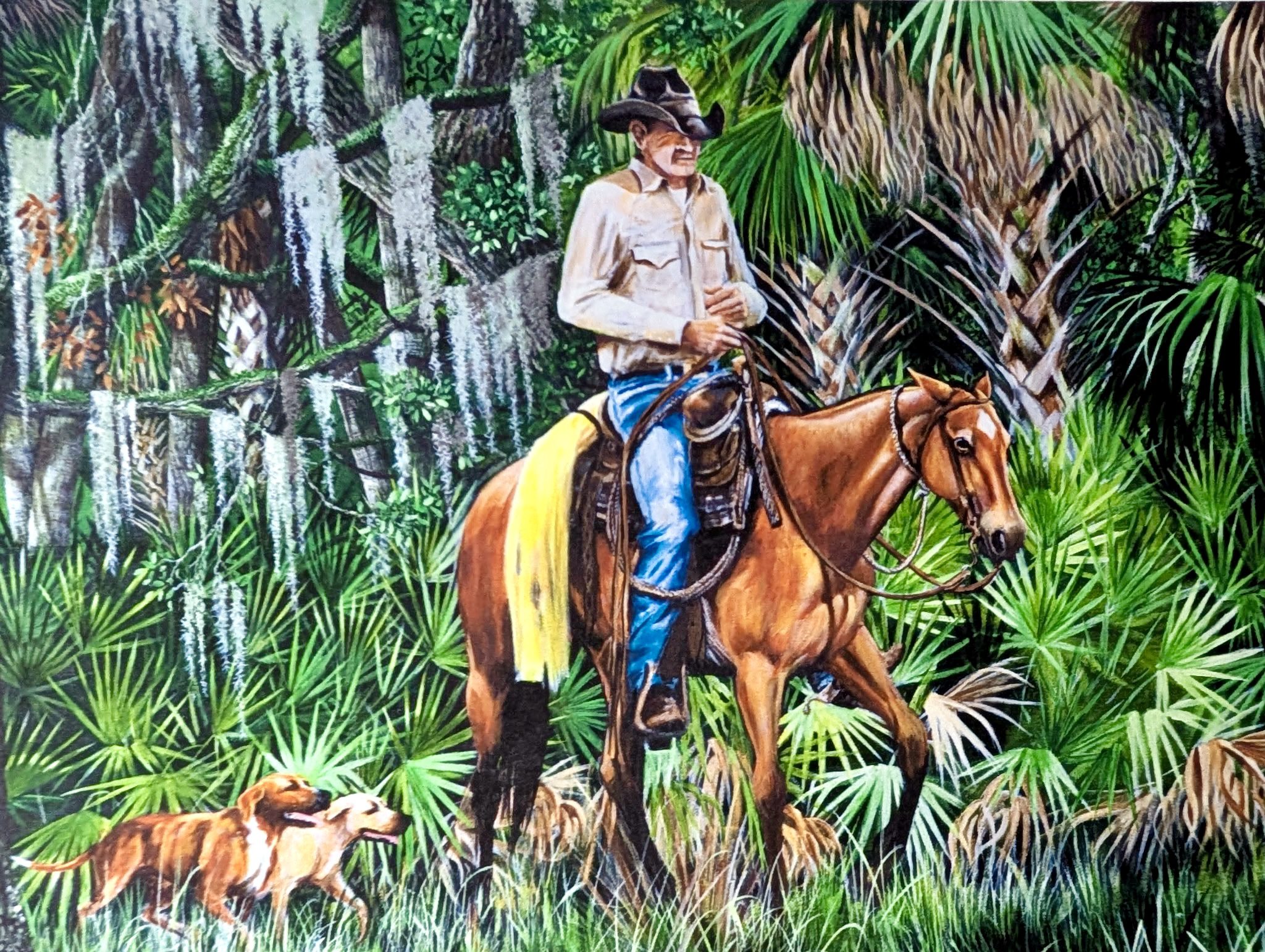
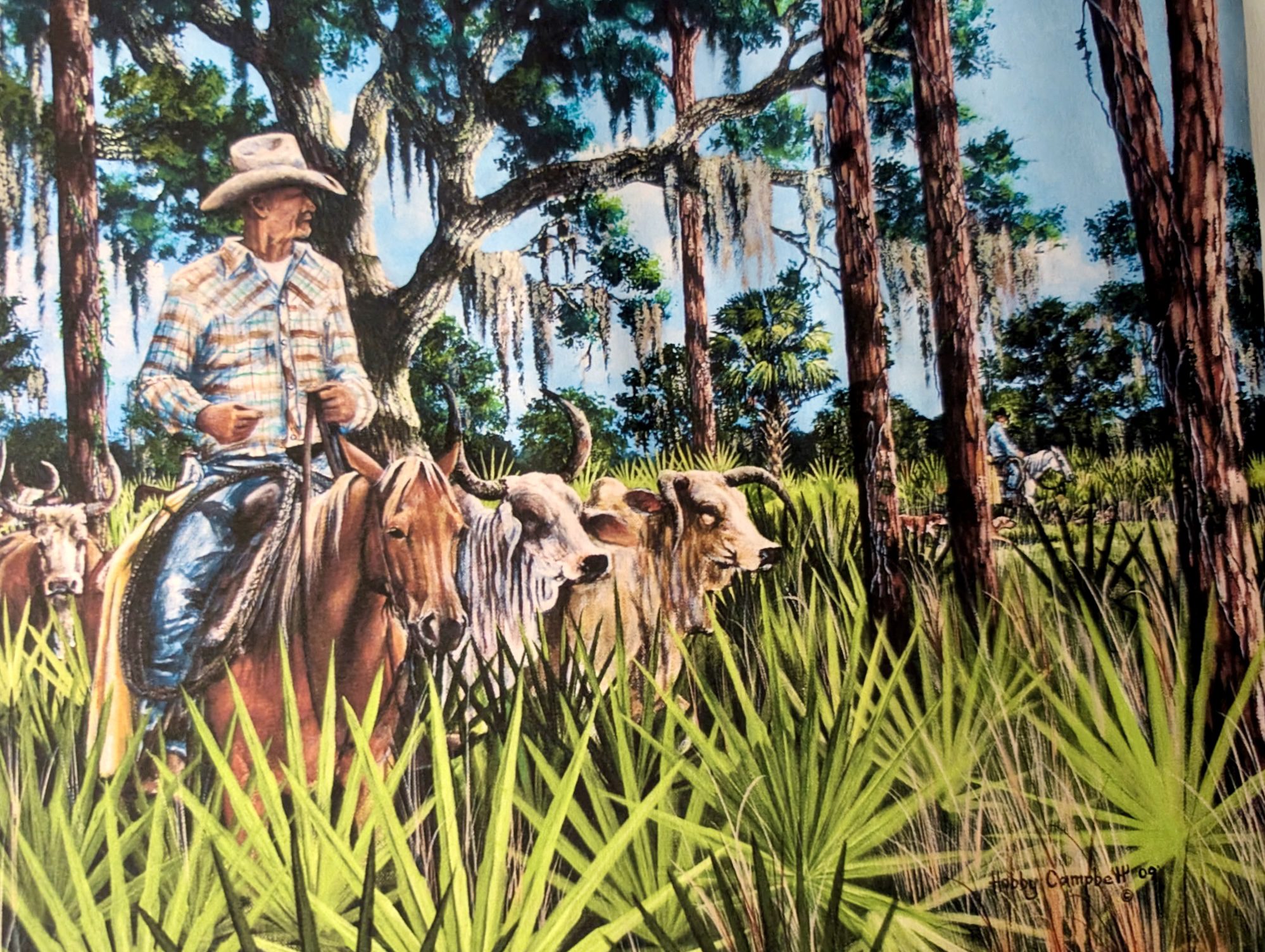
Hobby doesn’t paint from photographs unless he has to. He paints from memory, built over a lifetime of rodeos, ranch work, and long days in places most people will never see. As he put it, there “wasn’t nothing around but horses and cows… that’s all I knew.” That foundation is what separates his work from imitation. You can’t fake what you haven’t lived, and according to Hobby, you can’t fool an old cowboy either.
That standard—being believable to the people who know—shows in everything he creates. It’s why the details matter: the way a saddle sits, the way a cow turns its head, even the smallest, almost invisible elements like a scrap of nylon string tied to a saddle horn. They’re there for a reason, not for the casual viewer, but for the ones who know what they’re looking at.
And make no mistake, they do notice.
Hobby told me he’s watched old cowboys stand in front of his work for half an hour at a time, just studying it. Not saying much. Just looking. That, more than anything, is how he knew he had gotten it right.
One piece in particular, Cracker Necktie, changed everything.
Painted in the mid-1990s, it was the first work that truly broke through—not just as art, but as something recognized within the cattle community itself. It circulated through the Florida cattle world, drew attention from people who lived the life it depicted, and established Hobby as more than just another painter trying to capture cowboy life from a distance.
A large print of Cracker Necktie hangs in the living room of cowboy, artist, and storyteller Joe Johnson. The two haven’t met, but they might as well have.
When Johnson talked about the piece, he didn’t describe it like a viewer. He described it like someone recognizing something familiar. The realism, the detail, the feel of it—it wasn’t just a painting to him. It was his life, his work, looking back at him.
That’s about as high a compliment as you can get, especially from someone who can spot the difference between something that’s painted well and something that’s lived. That’s the line Hobby walks in every piece he creates. What he’s painting isn’t just a scene; it’s a record. A record of a Florida that is still here, but not in the way it used to be.
Ranches that once ran thousands of head have been cut down, sold off piece by piece. Land that held cattle, wildlife, and open ground is being reshaped, repurposed, or lost entirely. As Hobby put it plainly, once it’s gone, “it ain’t coming back.” That reality sits just beneath the surface of the work.
It came into sharper focus as we drove. Hobby talked about a man he knew—someone he had worked for—whose family once ran a large operation. What had supported thousands of cattle was broken apart over time, sold parcel by parcel until only a fraction remained. The money might be there for a while, but eventually it runs out. The land, meanwhile, is already gone.
And once it’s gone, it doesn’t come back as pasture or open range. It comes back as something else entirely—houses, roads, commercial development. The land changes function, and with it, everything tied to it changes too.
It’s not just a cultural loss. There’s an environmental one as well.
For years, some of the land around the Kissimmee River was purchased with the idea that removing cattle would allow it to return to a more natural state. But the reality is more complicated than that.
We don’t allow the natural fire cycle to occur the way it once did. Controlled burns help, but they don’t fully replace that process. And with invasive species now established across much of Florida, something still has to manage the land, keep growth in check, maintain balance, and prevent those systems from being overrun. For generations, well-managed cattle grazing has filled that role.
When handled properly, cattle control vegetation, limit woody overgrowth, and help maintain open grasslands. Those grasslands, in turn, play a critical role in how water moves across the landscape, slowing it down, allowing it to soak in, and filtering it along the way.
Remove that system, or replace it with development, and those benefits disappear. Water moves faster. Filtration drops. Flooding becomes more likely, and groundwater no longer replenishes the aquifers.
At the same time, many species have adapted to these working landscapes. They’ve found habitat within ranchlands that are still active, still managed, but still open. Replace that with concrete and density, and that balance collapses. What’s lost isn’t just open space. It’s a system that was working.
As our conversation moved through land loss, fragmentation, and the steady disappearance of rural Florida under a spread of concrete, we eventually circled back to what brought me there in the first place: the art.
It all ties together, but at the center of it is an artist whose work made me want to make the drive, sit down, and understand where it comes from.
Hobby’s work is often described as almost photographic in its realism, layered with detail that feels deliberate rather than incidental. But Hobby sees it differently. He believes he can paint a scene better than a photograph, and after talking with him, it’s not hard to understand why.
A photograph captures a moment, but it doesn’t always capture what you actually see. Your eye and your understanding pick up on depth, texture, and subtle details that a camera flattens or loses. What Hobby does is rebuild that scene in a way that makes those elements visible again.
These landscapes, ranches, hammocks, and open grasslands aren’t always obvious to someone passing through. It takes a trained eye—or more accurately, a lived connection—to see them fully. Hobby’s work gives you that perspective. It lets you see Florida through the eyes of someone who has spent a lifetime in it.
And that level of understanding shows up in the way he works.
At one point, looking at a piece in progress, he mentioned repainting the head of a turkey more than twenty times. Not because he couldn’t paint it, but because it didn’t meet his standard. He kept working it until it was right.
That kind of discipline carries through everything he does.
It’s also why he rejects shortcuts. Everything is built by hand, layered through time and effort. That commitment is part of what sets his work apart. It’s not just the result; it’s the process behind it.
When I asked him how he got started, his answer was simple: he’s been drawing for as long as he can remember.
Horses, cows, and rodeo—that was his world. His father was a cowboy, a ranch hand. He grew up in it, lived in it, and started by drawing what he knew: bucking horses, cattle, the movement of animals that were part of his everyday life.
He spent some time at art school in Palatka, but by his own admission, it didn’t last long. Rodeo took precedence. Life took precedence. In the end, that may have mattered more than anything formal training could have offered.
Because what defines his work isn’t just technique. It’s experience. A lifetime spent working cattle, riding, hunting, guiding, and living in the landscape he now paints. That depth is what gives his work its weight. It’s not observation from the outside. It’s knowledge from within.