By: James Kennedy
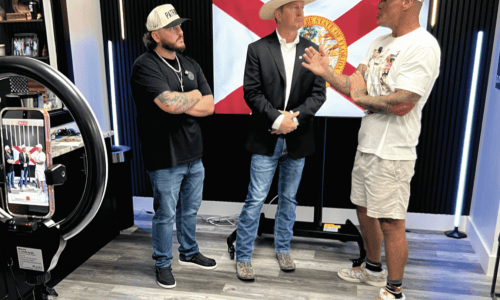
Before the recorder was turned on, Bobby Williams was already working the crowd, shaking hands, answering questions, and moving from one conversation to the next.
The setting was informal, but the message was consistent.
“Its accountability. Its credibility. It’s what are they producing?” Williams said during the meet-and-greet. “The fruit tells you everything.”
That idea—judging leadership by outcomes rather than promises—carried into a more structured interview that followed.
A Campaign Rooted in Frustration
Williams describes Florida as a state where dissatisfaction has become widespread and consistent.
“It doesn’t matter the race, the income, the background—everybody’s saying the same thing,” he said. “They’re frustrated, and nothing’s changing.”
He pointed to conversations across the state with teachers, health care workers, small business owners, and families trying to keep up with rising costs. In his view, the complaints are not isolated.
“Every county thinks they’re the only one,” he said. “But it’s the same everywhere I go.”
Rather than frame that frustration in partisan terms, Williams presents it as a broader loss of confidence in how Florida is being governed.
Development as the Defining Issue
At the center of his campaign is development.
Williams argues that Florida is no longer simply growing, but expanding beyond its ability to support that growth. Roads, water systems, and infrastructure, he says, have not kept pace with the pace of residential construction.
“We can’t handle more,” he said. “We can’t handle the traffic, the water, the infrastructure. People have had enough.”
He draws a distinction between development that fills a genuine need—such as services in underserved areas—and large-scale housing expansion in already strained regions.
When asked directly, he does not avoid the label often applied to his campaign.
“They call me anti-growth, and I am—because we can’t handle it.”
Responsibility Across the System
Williams does not isolate responsibility to one group.
“All of the above,” he said when asked who is responsible—citing local governments, state leadership, and developers.
His criticism is particularly directed at large development firms, which he argues are not paying the full cost of the infrastructure required to support their projects.
“These national developers are what’s really destroying Florida,” he said. “They should be paying for all of it.”
Infrastructure Before Expansion
A key part of his platform is restoring the link between development and infrastructure.
“We’re 15 to 25 years behind on infrastructure,” he said. “How do you ever catch up if you keep building?”
He supports stronger requirements that infrastructure be in place before major development is approved and suggests giving residents more direct input on large projects.
“If a development’s going in, the people should vote on it,” he said. “What we’ve been doing hasn’t worked.”
Agriculture as Policy
Agriculture is central to Williams’s campaign, not secondary.
“It’s all the same—rural land, woods, agriculture—it’s all the most important thing,” he said.
He frames farmland preservation as both an economic issue and a matter of food security.
“We can’t depend on foreign entities for our food,” he said. “We’ve got to be able to feed ourselves.”
His position is direct: “If it’s ag, it needs to stay ag. No more rezoning.”
A State Meat Processing Proposal
Williams also proposes creating a state-supported or cooperative meat processing system to support ranchers.
“We’ve only got four major packers left, and most are foreign-owned,” he said. “That creates a monopoly.”
The goal, he said, would be to give producers more options and keep more of the agricultural economy within Florida.
“It’s about food security, lowering costs for ranchers, and helping Florida feed itself.”
Housing and Incentives
During the earlier meet-and-greet, Williams addressed housing and public assistance programs, focusing on how they are structured.
“The way it’s set up, why would you want to make more money if your rent just keeps going up?” he said.
He argued for systems that allow people to stabilize financially while working toward independence.
“It shouldn’t be a lifetime system; it should be a way out,” he said.
He also said that if public housing is viewed as unsafe or undesirable, the solution should be to improve conditions.
“If people say it’s dangerous, then fix it—don’t just accept it.”
Education and Workforce Readiness
Education is another area he identifies as needing change.
“K–12 is broken,” he said. “We’ve got to get trades back, life skills, budgeting, things people actually need.”
He emphasized preparing students for multiple pathways, not just college.
“Right now, they’re not equipped for anything when they leave,” he said.
Water, Utilities, and Accountability
Environmental concerns, particularly water quality, are tied closely to his views on development.
“We’re polluting our waterways, we’re stressing our systems,” he said.
He also raised concerns about state boards and regulatory bodies, arguing they often operate without enough accountability to the public.
“Every time they come for an increase, they get it,” he said, referring to utilities. “Who’s fighting for the people?”
Governing Approach
When asked how he would address the influence of development interests, Williams pointed to executive authority.
“As governor, you’ve got veto power,” he said. “If it doesn’t help Floridians, it’s not getting signed.”
Campaign Structure and Strategy
Williams describes his campaign as operating outside traditional funding models.
“I self-fund most of it,” he said. “The rest comes in $50, $100 at a time.”
He also emphasized the role of social media.
“Social media is free, and everybody’s on it,” he said.
At the same time, the pace and interruptions of both the meet-and-greet and interview reflected another part of his approach: direct engagement.
“When people hear you in person, it’s different,” he said. “They’re looking for truth.”
A Campaign Framed Around Outcomes
Williams’s campaign is built around a consistent premise: Florida’s challenges—growth, infrastructure, affordability, and environmental strain—are connected and visible in daily life.
“You know them by their fruit,” he said. “And the fruit of what we’ve got right now, it’s not working.”
Whether that message resonates statewide remains to be seen. But the campaign is structured around a single question that runs through each issue he raises:
What has leadership produced, and is it enough?