By James Kennedy
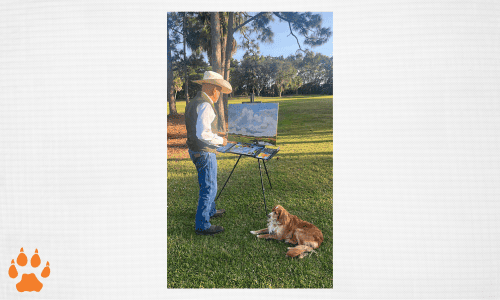
We continue our walk through the gallery of Cracker Cowboy art started several months ago. The series has included Eldon Lux and Hobby Campbell, whose work documents Florida’s cattle culture for new audiences. Now we turn to Brendan Fisk, another artist whose path into that culture was entirely his own.
Fisk grew up in New York, served in military intelligence during the Vietnam War, and spent a career with the FBI. Along the way, he developed a lifelong interest in painting. Through horses, Florida ranch country, and a well worn copy of A Land Remembered, he found himself drawn into Florida’s cattle culture, making it one of the central subjects of his work.
I sat down with Brendan over lunch at Gladys’ Restaurant, the oldest restaurant in Okeechobee, for a conversation about old Florida and the art that helps preserve it.
“I have always painted,” he wrote. “Color, shape and light are how I see the world.”
Today, Fisk is one of a small group of artists documenting a side of Florida many residents never encounter: working cowboys, cattlemen, ranch families, rodeos, and the vast landscapes that still define much of the state’s interior.
Even during his years in the military and the FBI, painting never left him. He recalled painting the aftermath of a rocket attack in Vietnam using three buckets of paint and a piece of plywood found on base.
In New York City, Fisk developed a lasting appreciation for the Impressionists, particularly Monet, and found inspiration in Edgar Payne and Jim Wodark.
Fisk credits Patrick Smith’s A Land Remembered with opening a door. The novel’s portrayal of Florida’s frontier cattle culture sparked an interest that quickly became something deeper.
Fisk first rode the Cracker Trail and later joined the Great Florida Cattle Drive, seeing firsthand the landscapes and people that had captured his imagination. He eventually bought a small property in Okeechobee, acquired horses, and began raising cattle sold through the Okeechobee cattle market.
“Five horses later, I was totally immersed in the culture.”
He discovered a way of life that felt familiar despite being far removed from his New York upbringing. Again and again, he encountered honesty, responsibility, commitment, faith, and hard work.
Fisk described a culture where one’s word is a bond, reflected in daily work and community life. Rodeos often begin with prayer, and many of the cowboys and ranch families he met openly expressed their Christian faith.
“I felt right at home in this culture.”
That sense of belonging reshaped his artistic focus. Before cowboys and cattle entered his paintings, Fisk was drawn to Florida’s landscapes, particularly the open prairie and immense cloud formations of the interior.
“These are our mountains here in Florida. The clouds.”
Western painters find grandeur in mountain ranges and canyons. Fisk finds it in endless horizons, towering thunderstorms, and cattle moving across open range. The landscape is rarely just a backdrop. The rider, the horse, the cattle, the light, and the land work together to create the moment he is trying to capture.
Fisk describes his style as both representational and impressionistic. His goal is not photographic accuracy.
“My objective is to show movement and draw in the viewer.”
Horses surge through rodeo arenas. Cowboys cross creeks. Cattle stream across pastures. Working dogs weave through herds. The scenes are alive with motion, but Fisk avoids excess detail.
“I want the viewer to fill in the blanks.”
He focuses on atmosphere, color, light, and the emotional truth of a scene. A camera may record what happened. Fisk wants his paintings to convey what it felt like to be there.
At a recent Okeechobee Main Street Gallery event, painter Samantha White studied several of Fisk’s works, drawn by his use of color and his ability to convey motion and tension.
One striking work, Hang On, captures a bronc rider mid violent ride. Fisk described motion as one of the hardest things to achieve on canvas. The painting succeeds because it conveys movement and tension without unnecessary detail.
Other works explore different aspects of the culture. In Cooling Off, a rider moves through water beneath vibrant color and reflected light. In Summer Pasture, cattle move across an open landscape in a scene Fisk called mesmerizing. Branding scenes, creek crossings, working dogs, and day working cowboys appear throughout his portfolio.
Two of Fisk’s paintings are currently on display at the Alva Museum as part of the Cracker Cowboy Frontier exhibit, telling the story of Florida’s cattle and cow hunter traditions.
What connects these paintings is authenticity.
“When I’m painting these moments in a cowboy’s life, I’m there, present in the moment, or have done the same thing on horseback.”
Although Fisk did not grow up in Florida’s cattle culture, years riding horses, raising cattle, and building relationships within the ranching community gave him a personal connection to the people and places he paints.
Florida’s cattle culture remains invisible to much of the state. Beaches, theme parks, and coastal skylines dominate public perception, while the ranches, prairies, and working cowboys of the interior often go unnoticed.
“The Florida cowboy is relatively unknown on a national level compared to the western cowboy,” Fisk said.
That reality is one reason he keeps painting the subject. He wants the people he paints to recognize themselves in the work. Whether depicting a herd crossing water, a cowboy working alongside cattle dogs, or a rider framed against one of Florida’s immense skies, Fisk’s work is rooted in moments from a life many Floridians never see.
For Brendan Fisk, success is not measured by awards, gallery sales, or recognition. It is measured by whether the people he paints can stand in front of a painting and recognize something true.
In a state often defined by beaches, tourism, and rapid growth, Fisk points his easel toward another Florida, one of horses, cattle, prairie horizons, towering clouds, and people still making a living on the land.
It is a Florida many residents never see. Through his paintings, he hopes they will.
Postscript: More of Brendan Fisk’s work can be found at fiskfineart.com. Brendan can be reached at fiskfineart@gmail.com or (203) 521-1369.